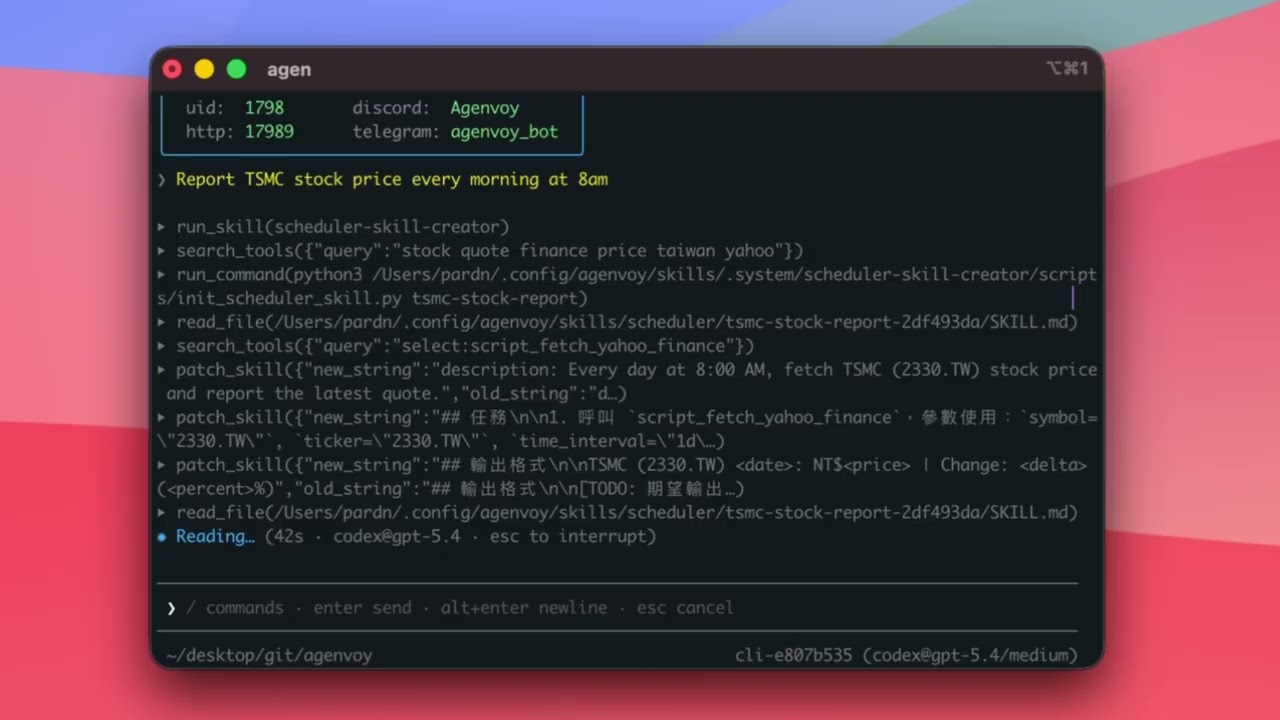
A self-hosted agent harness on your own machine — say what you need in one sentence, and it builds the tool, tests it, and reuses it.
Every tool is sandboxed and shared with Claude Code, Codex, and any MCP agent.
curl -fsSL https://agenvoy.com/scripts/install.sh | bash
Manage sessions, tools, schedules, and memory from a browser. Open web.agenvoy.com once the daemon is running on your machine — it connects to your local agent, nothing leaves your device.
Auto-built tools and a built-in MCP server at the core — plus multi-model routing, scheduling, and memory, all in a single Go binary.
Ask for anything. If no tool exists, the agent builds one — writes the script, tests it in a sandbox, and registers it. Next time, it's already there.
Server mode shares every sandboxed tool with Claude Code, Codex, and any MCP client — which can auto-build new tools too. Client mode calls external MCP services.
Ten providers behind one interface, plus any OpenAI-compatible endpoint. The dispatcher routes each task to the best model automatically.
Cron jobs and one-shot tasks with skill binding. Daemon fires them, hot-reloads on change, auto-disables on failure.
Context window, semantic vector search, full-text SQLite archive. Tool failures and their fixes persist across sessions.
Every command and script runs inside an OS-native sandbox — bubblewrap on Linux, sandbox-exec on macOS.
Loadable markdown instruction packs with YAML frontmatter. Slash-command activation, natural language trigger, or cron-bound.
When a tool fails, the agent rewrites it, sandbox-tests it, and retries — the fix and whether it worked carry into later sessions. Every file the tools touch is snapshotted, so a version or a whole task can be restored.
Optional KuraDB child process for external document search. Keyword + semantic dual-track over your personal knowledge base.
When no tool fits a request, the agent builds one in real-time — finds an API, writes the script, tests it, and saves it for reuse. No code required.
User asks for live data. No matching tool found.
→Search public APIs, fetch docs, pick the best match.
→Generate script + schema. Run test_tool to verify.
→Execute the new tool. Auto-persisted for all agents.
One config line gives Claude Code, Codex, and any MCP agent your entire sandboxed tool library — and they can auto-build new tools that everyone instantly shares.
Any MCP-compatible agent connects via stdio and gets access to all tools — built-in, script, API, and extension.
Connect third-party MCP servers via stdio or HTTP/SSE. Tools auto-registered and available to the agent immediately.
Same agent, same tools, same memory — accessible from terminal, chat apps, HTTP, or other AI agents.
Interactive terminal with slash commands and session switching
OTP-authenticated bot with HTML output and voice
Guild-verified bot with markdown and button confirms
OpenAI-compatible chat completions endpoint
Expose tools to Claude Code, Codex, and more
Ten model providers behind one Agent.Send() interface, plus a local/custom endpoint. OAuth routes — Codex, Copilot, xAI subscription — are authentication paths, not extra providers. The dispatcher auto-routes each task to the best model.
Related actions sit behind one name and a mode argument instead of a dozen near-identical tools. Only five ship with full schemas — the rest arrive as a name and a description and load their parameters on first use, keeping the initial payload at about a third of the registry. Missing a tool? The agent builds it.
Locate, read, edit and roll back files. Every change is recorded, so one version — or an entire task — can be put back.
Discover what already exists, author new tools and skills, sandbox-test one before it goes live.
Web results and news headlines in one call, a page as markdown, or a raw HTTP request with multipart upload.
Run a binary under sandbox constraints, hand a file to the OS, fetch an asset, install a missing dependency.
Delegate a subtask to its own session, queue timed and recurring runs, keep a live checklist, pause for an answer.
The session's own action log, tool failures kept across sessions with what fixed them, reasoning rules pulled in by topic.
Arithmetic and unit conversion, keychain-stored secrets. Transcription and chat push register only once their credentials exist.
Auto-generate tools from natural language. Drop scripts, API descriptors, or connect an MCP server — KuraDB RAG arrives this way.
One command to install, one command to start. Add a provider and you're ready.
Single binary. macOS and Linux.
curl -fsSL https://agenvoy.com/scripts/install.sh | bash
TUI opens. Daemon auto-starts.
agen
In the TUI. Any of 10 providers; the key goes to your keychain.
/model
Name it. Persists across restarts.
/new